
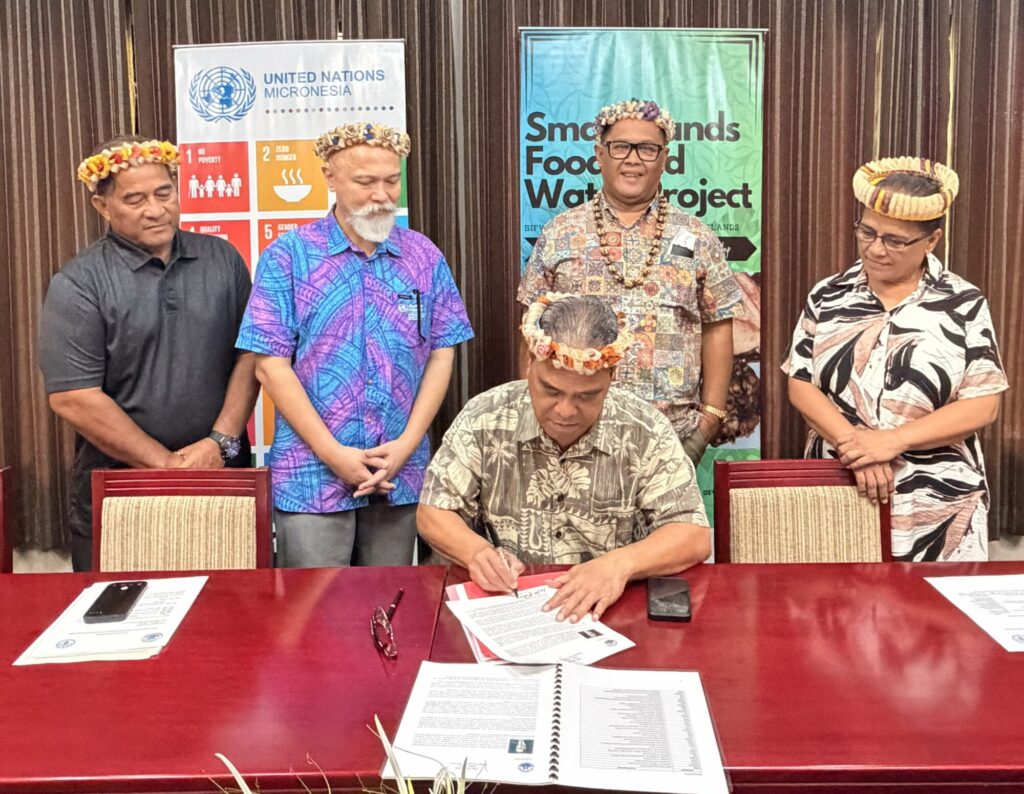
 PALIKIR, Pohnpei — July 27, 2026 — His Excellency Wesley W. Simina, President of the Federated States of Micronesia (FSM) officially signed the National Agriculture Investment Plan (NAIP) during a ceremony held at the Office of the President in Palikir on July 20, 2026.
The ceremony was attended by Lieutenant Governor Mekioshy William of Chuuk State; Lieutenant Governor Arthy Nena of Kosrae State; Lieutenant Governor Herolyn S. Movick of Pohnpei State; Secretary Elina Akinaga of the Department of Resources and Development; Secretary Rose Nakanaga of the Department of Finance and Administration; and Dr. Rodrigo Ofrin, Officer in Charge of the United Nations Multi-Country Office, Micronesia, along with representatives of the national and state governments and development partners.
The National Agriculture Investment Plan was developed through an inclusive and consultative process involving the national government, the four state governments, farmers, communities, and other stakeholders. Its preparation was supported under Component 3 of the Small Islands Food and Water Project (SIFWaP) and implemented by the Food and Agriculture Organization of the United Nations (FAO).
The NAIP establishes a national framework for agricultural investment and identifies five priority areas for the development of the FSM agriculture sector: increasing the production and productivity of crop farming systems; increasing the production and productivity of the livestock sector; strengthening biosecurity services; promoting high-value horticulture value chains and linkages to local markets; and enhancing training, capacity development, and institutional support. Together, these priorities respond to the need for stronger and more coordinated support for farmers across the nation.
President Simina recognized the contributions of the state governments, communities, farmers, technical experts, and stakeholders who contributed to the development of the Plan through consultations across Yap, Chuuk, Pohnpei, and Kosrae.
President Simina also acknowledged the important role of FAO in implementing the preparation of the NAIP and expressed appreciation for the support provided through the Small Islands Food and Water Project.
The President stressed that the signing of the Plan marks the beginning of implementation.
“Today, however, our work is only beginning,” President Simina said. “The true measure of this Plan will not be the quality of the document itself, but the results it delivers.”
In his special remarks, Dr. Rodrigo Ofrin, Officer in Charge of the United Nations Multi-Country Office, Micronesia, congratulated the Government of the FSM and the Department of Resources and Development on the signing of the Plan and recognized the collaborative process through which it was developed.
Dr. Ofrin further emphasized that the signing marks the beginning of the work ahead.
“The true measure of success will not be today’s signing, but the implementation that follows,” he said. “Turning this vision into tangible results will require sustained political commitment, effective coordination across national and state governments, meaningful participation of local communities, and continued engagement from partners across all sectors.”
He reaffirmed the United Nations system’s commitment to supporting the FSM in the implementation of the Plan, including through strengthening institutional capacities, mobilizing investments, promoting innovation, supporting evidence-based policymaking, and facilitating partnerships.
President Simina also emphasized the importance of continued investment in young people and the opportunities available in modern agriculture, including innovation, entrepreneurship, science, technology, and sustainable resource management.
The President called for continued action and investment to strengthen the nation’s food systems and resilience.
“The El Niño season before us reminds us that we cannot wait until a crisis arrives before taking action,” the President said. “This National Agriculture Investment Plan represents our commitment to invest before those challenges become emergencies—to strengthen our food systems, safeguard our natural resources, support our farmers, and build lasting resilience for future generations.”
The signing of the NAIP represents a significant step toward establishing a coordinated national framework for agricultural investment and development. Its implementation will require continued cooperation among the national and state governments, communities, farmers, development partners, traditional leaders, educational institutions, and the private sector.
###